If you’re wondering where “Tot School” got its name, check out 1plus1plus1equals1’s awesome resources!
What is Tot School?
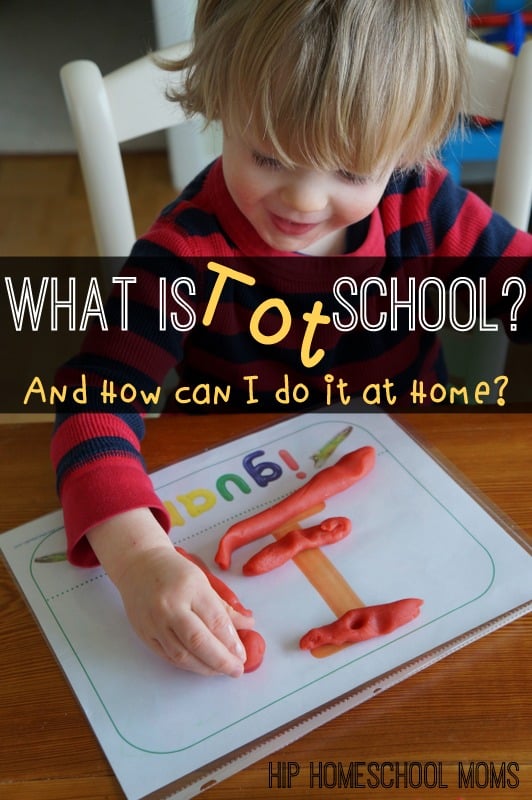
What is Tot School? And how can I do it at home? Questions I am often asked. We have been having a wonderful time with in-home Tot School for over a year now and I wanted to share some tips on how easy it can be! Quite simply, Tot School is intentionally reading and playing with your child during the formative years of 1 to 3. This is before more official “Preschool” can take its place.
So, therefore, Tot School can be accomplished in two easy, intentional steps:
- Reading with your child
- Playing with your child
Reading
Reading books with your child is the best you can do for them to establish a strong foundation in literacy and learning. I like to make the rule in my house that I read with my children together and a part — for at least 15 minutes. We also have the rule that if one of our children wants to read a book, we drop everything and read!

Reading can also include introducing letters and numbers in a fun and non-intimidating way. We choose to start with uppercase letters first. Check out my Early Literacy Stages series to read more about the developmental periods of literacy learning for young children. They include:
- Uppercase letter recognition
- Tactile uppercase letter writing
- Utensil prewriting and uppercase letter writing
- Lowercase letter recognition (and matching uppercase with lowercase letters)
- Lowercase phonetic sounds
- Lowercase letter writing
Playing
Playing = learning. Every child deserves time to play. As a former kindergarten teacher who taught full-day kindergarten, I am a strong advocate against structured “in your seat” learning (or all day school) for young children. I know this is impossible for many families who utilize day care, etc., however, I believe in allowing children the freedom to play during these early formidable years.
The young days of play will not last forever. Children will grow up and leave our nests long before we are ever ready. So let’s not push them into reading and writing letters before they are ready! There are some children who will crave holding a crayon or marker or pencil and will write letters very early, but there are still some 4 and 5 year olds who have yet to recognize, or write, their first set of letters (upper or lowercase). Every child learns at a different pace. We need to teach without pushing.
Instruction should last for no more than an hour before the age of 5. The rest of their time should be spent playing. And of course this can include arts and crafts, independent play, coloring, structured activities, sensory play time, outdoor & nature play, boredom, all of the above. But don’t force reading and writing and “school” — real school and curriculums — until at least 5 years of age.
How to encourage learning through play?
- You can use toys you already have and items from around your home to further your child’s learning time. Melissa & Doug toys are wonderful for unstructured play. Think wooden toys, stackable items, chunky lacing beads, shapes, non-electronic, incorporating letter work. The below toys are Melissa & Doug Shape Puzzles and Lauri Alphabet Pegs.
- Sensory play can include bins with bases of beans or rice or corn, or simpler activities like using shaving cream or a bowl of water or a shallow tray of salt. Sensory play can teach children important concepts of transferring, straining, pouring, scooping, drawing with a finger.
- Using activities on Tot Trays are a unique way to present activities and foster development of fine and gross motor skills. Some of the learning choices for this type of organized play are: Numbers, Lacing, Magnets, Colors, Shapes, Letter review, and Practical Life Tot Tray ideas.

You can set up any number of activities on a tot tray for your child. Some activities could include:
- Cutting out number cards and using with a math manipulative (teddy bear counters, unifix cubes, any other small block or toy)
- Include a lacing card with either a lace card and string or a homemade one with some neat clip links.
- Magnet page for that week’s letter (from Homeschool Creations, Making Learning Fun, or Confessions of a Homeschooler) with magnets or pom pom magnets
- Color tray: Set out a color sensory bowl (to play hide and seek with a cloth on top) or put out crayons and little pictures to practice early coloring skills.
- Shape tray: Matching shapes with printables or finding shape objects around the house.
- Letter review: There are many alternatives to simply “coloring” while learning letters and numbers — such as using Do a Dot markers, using stickers, stamping, placing various objects on letters, there are so many options! You can also have fun with magnet letters or various alphabet games.
Some children don’t want to sit and “do school” or “color” — and that’s okay! My son is one of those — he likes to “do school” for a couple minutes, and I won’t push him to do more than that until he is around 5 years old. As homeschooling parents, we can connect to our children in many different ways, so follow your child’s interests!
- There are so many free printables out there to utilize from various places. Here are the places I go to find free learning materials.
- Only Passionate Curiosity
- 1plus1plus1equals1
- Homeschool Creations
- Royal Baloo
- Confessions of a Homeschooler
- Wildflower Ramblings
Here are all of our Tot School Posts – from A to Z!


Find more ideas here.
And check out:


